
SELENOID
R900086685 POPPET DIRECTIONAL VALVE M-3SED10CK1X/350CG24N9K4
General
The directional valve of the type M-.SED is a direct operated directional seat valve with solenoid actuation. It controls the start, stop and direction of flow and mainly consists of a housing (1), the solenoid (2), the valve seats (7) and (11) as well as of the closing element (4).
The manual override (6) allows for the switching of the valve without solenoid energization.
Basic principle
The initial position of the valve (normally open “UK” or normally closed “CK”) is determined by the arrangement of the spring (5). The chamber (3) behind the closing element (4) is connected to port P and sealed against port
T. Thus, the valve is pressure-compensated in relation to the actuating forces (solenoid and spring).
With the special closing element (4), ports P, A and T can be loaded with the maximum operating pressure (350 bar) and the flow can be directed into both directions (see symbols)!
In the initial position, the closing element (4) is pressed onto the seat (11) by the spring (5), in spool position, it is pressed onto the seat (7) by the solenoid (2). The flow is blocked in a leak-free manner.
With a sandwich plate, the Plus-1 plate, under the 3/2 directional seat valve, the function of a 4/2 directional seat valve is achieved.
Function of the Plus-1 plate
- Initial position:
The main valve is not operated. The spring (5) holds the closing element (4) on the seat (11). Port P is blocked and A is connected to T. Apart from that, one control line is connected from A to the large area of the control spool (8), which is thus unloaded to the tank. The pressure applied via P now pushes the ball (9) onto the seat (10). Now, P is connected to B, and A to T.
- Transition position:
Upon actuation of the main valve, the closing element (4) is shifted against the spring (5) and pressed onto the seat (7). During this, port T is blocked, while P, A, and B are briefly connected to each other.
- Switching position:
P is connected to A. Since the pump pressure acts via A on the large area of the control spool (8), the ball (9) is pressed onto the seat (12). Thus, B is connected to T, and P to A. The ball (9) in the Plus-1 plate has a “positive spool overlap”.
General Inquiries
There are no inquiries yet.

Related products
-
Add to cart
Flat Panel LED dengan cahaya menyebar biasa digunakan untuk industri Farmasi, Makanan dan Museum.
FlatPanel LED dipakai untuk mengganti lampu yang sudah terpasang dengan Kap RM (reflective MIrror Double T8) Existing. Karena Flatpanel led tidak memiliki celah, debu tidak bisa masuk dan berkumpul sehingga membuat FlatPanel LED bersih dan aman digunakan terutama untuk area sensitif seperti dapur (pembuatan makanan) dan farmasi (pembuatan obat) di mana hasil ahkir produk berpengaruh terhadap kesehatan manusia.
Fakta Teknis :
1. 2 Tahun garansi
2. Input Power : AC220-240 Volt
3. Power Consumption : 48 Watt
4. SMD4014 – 204 leds
5. Beam Angle : 120°
6. IP20 – Indoor uses
7. Luminous : 4,300 Lumens
8. Efficiency: 90 Lumens / Watt
9. CRI : 80
10. Size : 60 cm X 60 cm X 1 cm (Tebal)
11. CCT : 3,000K , 4000K, 6500K – mohon tanya ketersediaan stock terlebih dahulu -
Add to cart
Rumah lampu Fixture MR16 LED dengan kaca anti-glare agar penghuni ruangan tidak menatap cahaya silau dari samping titik lampu.
Rumah Lampu Fixture MR16 LED kaca ini mencegah glare langsung ke mata.
Fakta Teknis :
1. ANTI-GLARE
2. Untuk : MR16 LED Lights
3. Hole Size : 75 mm
4. Size : 85 X 45 (mm)
NOTE : Stock sudah tertulis, agar mempermudah proses transaksi , tidak perlu tanya lagi ketersediaan stock.
Tolong dibaca dan dipahami deskripsi terlebih dahulu. Membeli berarti paham dan setuju dengan spesifikasi yang tertera. Penjual tidak melayani retur atau tukar barang. Mohon klarifikasi ke penjual sebelum membeli apabila tidak yakin. -
Add to cart
Digunakan sebagai Saklar Lampu
Fakta Teknis :
*) Input Voltage ~ 250 Volt
*) Maximum Ampere 16A
*) Dimensi : 9 cm (Lebar) x 8.5 cm (Tinggi) x 3 cm (Tebal -
Add to cart
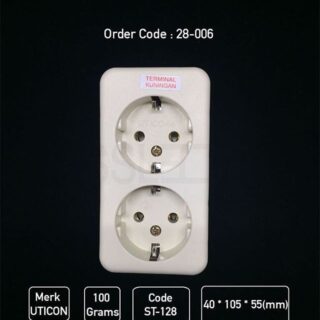
UTICON / Stop kontak Arde 2 Lb / Code : ST-128
Weight : 100 Gram
Size : 40 * 105 * 55 (mm)
Code : ST-128